![]() | |
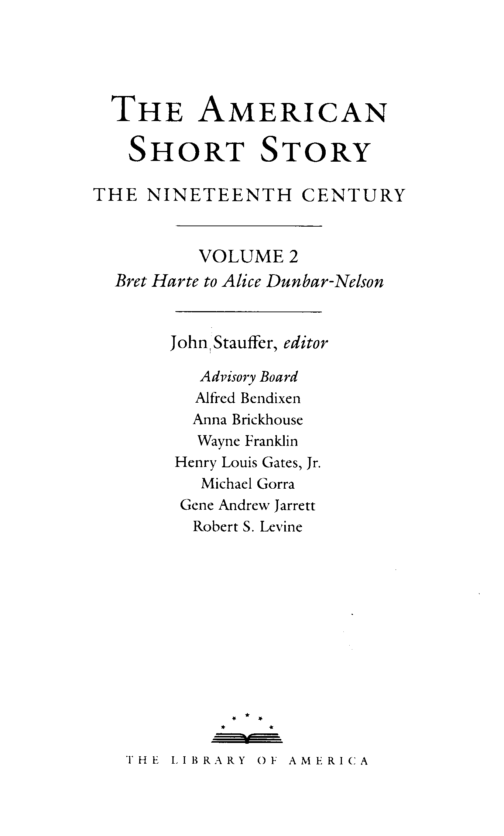
| "The second volume charts the evolution of the American short story from Bret Harte’s mid-century tales of the Gold Rush frontier to Alice Dunbar-Nelson’s “The Stones of the Village,” a story of racial passing written in 1900 but unpublished in the author’s lifetime. Edith Wharton, only getting started in the last decade of the century but already a highly accomplished short story writer, is represented by two breakout successes. The form achieves perhaps its fullest nineteenth-century flowering with Henry James, whose greatest masterpieces are showcased here. Here too are the superlative aesthetic accomplishments of the so-called local-color writers of the post–Civil War era. These indelible works by Constance Fenimore Woolson, Sarah Orne Jewett, Kate Chopin, Mary E. Wilkins Freeman, and others draw attention to regional character, dialect, and setting in exquisitely crafted fiction.Readers will encounter the starkly brilliant short fiction of Stephen Crane, portraying moments of extreme crisis, as well as indispensable works by Black writers Charles W. Chesnutt and Paul Laurence Dunbar, whose electrifying explorations of racial identity make inventive use of African American speech and folklore. Also included are works by the compelling and captivating folklorists George Chandler Harris and Thomas Nelson Page, unreconstructed white southerners whose sentimental pictures of their ancestral home are a striking counterpoint to Chesnutt’s and Dunbar’s fiction. Among the rediscoveries here are Francis Hopkinson Smith’s minor comic masterpiece “Six Hours in Squantico,” about a train traveler stuck in a backwater town, and Frank R. Stockton’s “The Lady, or the Tiger?” and its delightfully metafictional sequel, “The Discourager of Hesitancy.”" [Verlag] |
|
|